


Dialysis machines are critical tools in the treatment of kidney failure, helping patients maintain their health when their kidneys cannot function properly. Nearly 750,000 people in the United States and over 2 million worldwide suffer from kidney failure annually. Among these, 71% of patients in the U.S. diagnosed with End-Stage Renal Disease (ESRD) rely on dialysis. The two kidneys normally filter about 10,000 liters of blood each week. Dialysis machines replicate this vital process, ensuring toxins and excess fluids are removed from the body. With advancements in technology, different types of dialysis machines, including hemodialysis and peritoneal dialysis devices, address diverse medical and lifestyle needs effectively.
Key Takeaways
- Dialysis machines help people with kidney failure. They remove waste and extra fluids when kidneys stop working.
- Hemodialysis and peritoneal dialysis machines meet different needs. Hemodialysis works fast to clean the blood, while peritoneal dialysis lets patients have more freedom.
- Continuous renal replacement therapy (CRRT) helps very sick patients. It gently cleans the blood all the time for those with sudden kidney problems.
- Portable dialysis machines give patients more freedom. They allow treatment at home or during travel, making life easier and lowering infection risks.
- Picking the right dialysis machine depends on health needs, lifestyle, and cost. Talking to doctors helps patients make the best choice.
Hemodialysis Machines
How Hemodialysis Machines Work?
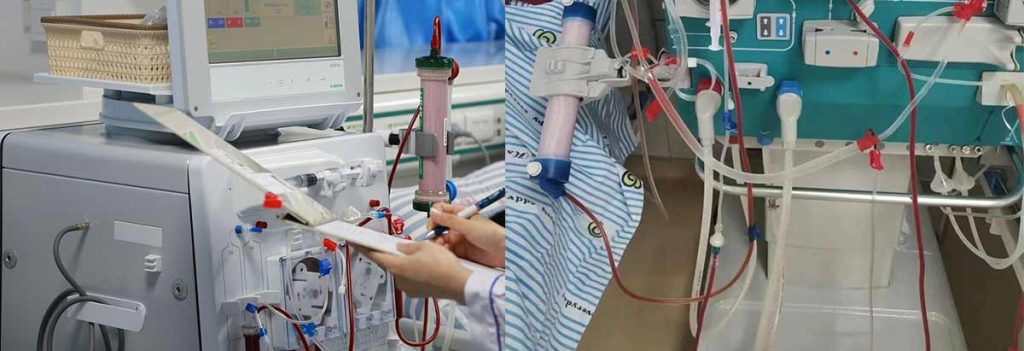
Hemodialysis removes waste, toxins, and excess fluids from the blood when the kidneys fail to perform these functions. A hemodialysis machine operates by drawing blood from the patient, filtering it through a dialyzer, and returning the cleaned blood to the body. This process mimics the natural filtration performed by healthy kidneys.
The machine consists of several key components:
- Extracorporeal Circuit: This system pumps blood from the patient, monitors pressure, and uses heparin to prevent clotting before the blood enters the dialyzer.
- Dialysate Circuit: This part prepares the dialysate, a special fluid that helps remove waste products and balances electrolytes. It often includes a bicarbonate buffer solution.
- Disinfection Circuit: After each session, the machine undergoes a thorough cleansing process to remove impurities and ensure safety for the next use.
Modern hemodialysis machines, such as the Tablo Hemodialysis System, are designed for both clinical and home settings. These machines simplify the process, making it more accessible for dialysis patients who prefer treatment outside of a hospital.
Clinical Applications of Hemodialysis
Hemodialysis is widely used to treat patients with End-Stage Renal Disease (ESRD) and acute kidney failure. It is particularly effective for individuals who require rapid removal of toxins or fluid overload. In critical care settings, hemodialysis stabilizes patients with severe electrolyte imbalances or life-threatening uremia.
A study conducted in an academic hospital highlighted the effectiveness of the Tablo Hemodialysis System in improving patient care and satisfaction. Patients reported fewer symptoms and better overall health when using this system. Another study demonstrated significant improvements in dialysis-related symptoms with thrice-weekly treatments, showcasing the system’s ability to enhance quality of life.
Clinical trials have also shown that hemodialysis machines perform auxiliary functions effectively without causing severe adverse effects. For example, a study involving 61 patients across five dialysis facilities found no significant difference in safety between test and control machines. This evidence underscores the reliability of modern hemodialysis technology.
Benefits and Limitations of Hemodialysis
Hemodialysis offers several benefits for dialysis patients with kidney failure. It effectively removes toxins, balances electrolytes, and manages fluid levels, which are critical for maintaining overall health. Patients undergoing hemodialysis often experience improved energy levels and reduced symptoms of uremia.
However, the treatment has limitations. Hemodialysis requires regular sessions, typically three times per week, which can disrupt daily routines. The procedure also involves the creation of an arteriovenous (AV) fistula or graft, which may require surgery. According to a survey, 95% of patients reported undergoing surgery for fistula creation, while only 4% were aware of minimally invasive options.
Another challenge is the risk of complications, such as infections or low blood pressure during treatment. Despite these limitations, advancements in technology, such as portable hemodialysis machines, aim to address these issues by offering greater flexibility and convenience for dialysis patients.
Peritoneal Dialysis Machines
How Peritoneal Dialysis Machines Work?
Peritoneal dialysis machines facilitate the removal of waste products and excess fluids by using the peritoneum, a membrane lining the abdominal cavity, as a natural filter. Unlike hemodialysis, this method does not require blood to leave the body. Instead, a sterile dialysis solution, known as dialysate, is introduced into the abdominal cavity through a catheter. The solution absorbs toxins and excess fluids from the blood vessels in the peritoneum. After a set dwell time, the used dialysate is drained and replaced with fresh fluid.
A comparative study highlights the importance of catheter placement techniques in peritoneal dialysis. Laparoscopic methods have shown a lower failure rate (2.8%-13%) compared to open techniques (10%-35%). This operational difference reduces complications and improves outcomes for patients undergoing peritoneal dialysis.
Types of Peritoneal Dialysis: APD vs. CAPD
Peritoneal dialysis offers flexibility through different types, including Continuous Ambulatory Peritoneal Dialysis (CAPD) and Automated Peritoneal Dialysis (APD), also known as Continuous Cycler-Assisted Peritoneal Dialysis (CCPD). Each type caters to varying patient needs and lifestyles.
- Continuous Ambulatory Peritoneal Dialysis (CAPD): CAPD does not require a machine. Patients manually perform exchanges of dialysate several times a day, allowing them to remain mobile and maintain their daily routines.
- Continuous Cycler-Assisted Peritoneal Dialysis (CCPD): APD uses a machine, called a cycler, to automate the filling and draining process. This method is typically performed at night while the patient sleeps, offering convenience and minimizing daytime interruptions.
Clinical data comparing CAPD and APD reveals differences in performance and patient outcomes:
| Parameter | APD Performance | CAPD Performance |
|---|---|---|
| Infectious Complications | Lower incidence of peritonitis reported | Higher incidence of peritonitis reported |
| Residual Kidney Function Maintenance | Faster decline in RKF noted in some studies | Longer preservation of RKF in some cases |
| Small Solute Clearance | Higher urea clearance, lower creatinine clearance | Generally higher clearance for larger molecules |
| Ultrafiltration Adequacy | Adequate UF volume typically achieved | May struggle with fluid balance in some cases |
Benefits and Challenges of Peritoneal Dialysis
Peritoneal dialysis provides several benefits for patients with kidney failure. It offers greater independence compared to hemodialysis, as patients can perform treatments at home. CAPD allows mobility during the day, while APD enables treatment during sleep. This flexibility improves the quality of life for many patients. Additionally, peritoneal dialysis preserves residual kidney function (RKF) better than hemodialysis in some cases, which can enhance long-term outcomes.
However, challenges exist. Dialysis patients may experience complications such as infections, including peritonitis, which is more common in CAPD. Maintaining sterile conditions during exchanges is critical to reducing this risk. Fluid balance can also be a concern, particularly in CAPD, where ultrafiltration adequacy may vary. Psychological and social dimensions, such as the burden of self-care and the impact on daily life, are significant factors that healthcare providers must address.
A systematic review of patient experiences highlights the importance of understanding these challenges. It emphasizes the need for healthcare professionals to consider physical, psychological, and social aspects to improve care and support for patients using peritoneal dialysis.
Continuous Renal Replacement Therapy (CRRT) Machines
How CRRT Machines Work?
Continuous renal replacement therapy machines provide a slow and continuous method of filtering blood, making them ideal for critically ill patients. These machines operate using three primary mechanisms: diffusion, convection, and adsorption.
- Diffusion involves the movement of solutes across a semi-permeable membrane due to concentration gradients.
- Convection removes solutes by dragging them along with the flow of a solvent through the membrane.
- Adsorption captures solutes on the surface of the membrane for removal.
CRRT machines feature advanced monitoring systems to ensure safety and efficiency. For instance, they use color-coded alarms to indicate operational status. A green alarm signals normal operation, while orange and red alarms indicate non-urgent and emergency issues, respectively. Operators must address these alerts promptly to prevent complications like filter coagulation or pressure fluctuations.
Uses in Critical Care for Acute Kidney Injury
Continuous renal replacement therapy is a cornerstone treatment for acute kidney injury (AKI) in intensive care units (ICUs). It is particularly effective for patients who are hemodynamically unstable. Studies show that CRRT accounts for up to 75% of dialysis treatments in ICUs. Its ability to provide continuous filtration helps manage fluid overload and severe electrolyte imbalances without causing sudden shifts in blood pressure.
Recent advancements have enhanced CRRT’s role in critical care. Predictive models now identify the need for CRRT up to 12 hours before clinical symptoms appear. This allows healthcare providers to intervene earlier, optimizing patient outcomes and resource allocation. However, research comparing CRRT with intermittent hemodialysis (IHD) suggests that the choice of therapy should consider the patient’s overall condition, as survival outcomes may not differ significantly between the two methods.
Advantages of CRRT for Unstable Patients
CRRT offers several advantages for patients with unstable conditions. It excels in precise fluid management, reducing fluid accumulation while allowing flexible adjustments based on the patient’s needs. Unlike other types of dialysis machines, CRRT maintains hemodynamic stability more effectively, making it the preferred choice for critically ill patients.
A meta-analysis highlights that CRRT reduces the risk of mortality associated with hemodynamic instability in AKI patients. It also minimizes the progression of kidney damage. Clinical guidelines recommend CRRT over intermittent renal replacement therapies for unstable patients, emphasizing its superior ability to manage delicate conditions. These benefits make CRRT an indispensable tool in modern critical care.
Portable Dialysis Machines
How Portable Dialysis Machines Work?
Portable dialysis machines are designed to provide flexibility and convenience for patients requiring regular dialysis. These machines replicate the functions of traditional hemodialysis devices but in a compact and lightweight form, making them suitable for home use or travel. They operate using advanced features such as a proportioning system, which mixes acetate dialysate from a concentrate and tap water, simplifying the preparation process. Low hydraulic-resistance dialyzers, like Kiil dialyzers, ensure efficient filtration of toxins and excess fluids.
Safety remains a priority in portable dialysis machines. Features such as negative pressure monitors and arterial pressure monitors help prevent complications during operation. Additionally, these machines utilize high-temperature disinfection methods, such as 85°C hot water, to maintain hygiene in the dialysate circuit. Technological advancements, including ultrafiltration control and bicarbonate dialysate, have further improved patient outcomes by enhancing the efficiency and safety of these devices.
Benefits for Travel and Home Use
Portable dialysis machines offer significant benefits for dialysis patients seeking greater autonomy and flexibility in their treatment. These devices enable patients to perform dialysis at home or while traveling, reducing the need for frequent visits to dialysis centers. This convenience enhances the quality of life by allowing patients to maintain their daily routines and travel more freely.
Key advantages include:
- Improved Quality of Life: Home dialysis options provide greater flexibility in scheduling treatments, leading to higher patient satisfaction.
- Reduced Costs: Patients save on travel expenses and time associated with in-center dialysis.
- Lower Infection Risk: Home-based treatments minimize exposure to infections commonly encountered in clinical settings.
Statistics show that portable dialysis machines significantly enhance patient autonomy. Their compact and lightweight design allows for use in various settings, making them ideal for individuals with active lifestyles. These benefits contribute to better clinical outcomes, as dialysis patients can perform more frequent or longer dialysis sessions in the comfort of their homes.
Innovations in Portable Dialysis Technology
Recent advancements in portable dialysis technology have revolutionized the field, making these machines more efficient and user-friendly. Companies like AWAK have developed wearable dialysis machines that reduce liquid management needs by 85% through sorbent technology. Ellen Medical Devices is working on a low-cost system that sterilizes water from any source to create peritoneal dialysis fluid, expanding access to treatment in resource-limited areas.
Other innovations include:
- Cloudcath: A sensor-enabled device for real-time monitoring of kidney health, providing valuable insights into patient conditions.
- Revalo’s PeritoneX®: A device that disinfects dialysis tubes at connection sites, enhancing safety for peritoneal dialysis users.
- Qidni Labs: A waterless mobile blood purification system, aiming to create a hemodialysis machine requiring minimal water.
These advancements reflect the growing demand for portable dialysis machines that cater to diverse patient needs. Regulatory support and patient empowerment further drive innovation, ensuring that these devices continue to evolve and improve.
Choosing the Right Dialysis Machine
Factors to Consider: Medical Needs and Lifestyle
Selecting the right dialysis machine involves evaluating medical requirements and lifestyle preferences. Patients must consider their knowledge of dialysis types, family support, and compatibility with daily routines. For example, automated peritoneal dialysis (APD) offers flexibility and better adjustment to active lifestyles but comes with higher costs. A study revealed that 69.39% of patients lacked understanding of APD, while 77.55% of families hesitated to support it due to financial concerns. Despite these challenges, APD patients often report fewer dialysis-related symptoms and improved quality of life compared to other dialysis options.
| Key Factors | Description |
|---|---|
| Patient Knowledge | Lack of understanding of APD affects choice (69.39%). |
| Family Support | 77.55% of families did not support APD due to high costs. |
| Lifestyle Compatibility | APD offers flexibility and better adjustment to patient lifestyles. |
| Cost Considerations | APD is more expensive than CAPD, impacting family support. |
| Quality of Life | APD patients report better quality of life and fewer dialysis-related symptoms. |
Understanding these factors helps patients align their medical needs with their personal circumstances, ensuring the chosen dialysis machine supports their overall well-being.
Consulting with Healthcare Providers
Healthcare providers play a crucial role in guiding patients through dialysis options. Discussions should integrate patient goals, values, and quality-of-life preferences. A study titled Communicating Treatment Options to Older Patients with Advanced Kidney Disease emphasized the importance of presenting dialysis and conservative management equally. This approach empowers patients to make informed decisions.
- Kidney doctors and nurses often prioritize dialysis as the primary treatment, but conservative management should also be considered.
- Asking patients about their hopes for the future can help tailor treatment plans to their needs.
- Balancing medical recommendations with patient preferences ensures a holistic approach to care.
Patients benefit from open communication with healthcare providers, as it fosters trust and helps them navigate the complexities of dialysis machines and their specific uses.
Balancing Convenience, Effectiveness, and Cost

Cost-benefit analysis is essential when choosing dialysis machines. In-center hemodialysis (IHD) eliminates equipment expenses, as dialysis centers cover these costs. Home dialysis options, such as home hemodialysis (HHD) and peritoneal dialysis (PD), reduce transportation expenses but may increase utility bills due to higher water and electricity usage. Peritoneal dialysis is the most cost-effective option, averaging $53,000 annually per patient. Home hemodialysis costs approximately $60,000, while in-center hemodialysis is the most expensive at $78,000 per year.
- In-center dialysis sessions are typically covered by insurance, including Medicare, which pays 80% after the deductible.
- Home dialysis offers convenience and flexibility but requires patients to manage additional costs.
- Frequent or longer dialysis sessions at home can improve clinical outcomes, making the investment worthwhile for some patients.
Balancing these factors allows patients to choose a dialysis machine that aligns with their financial situation, lifestyle, and health goals.
Conclusion
Dialysis machines play a crucial role in managing kidney failure. Each type, including hemodialysis, peritoneal dialysis, CRRT, and portable devices, serves specific medical and lifestyle needs. These machines offer unique benefits, such as flexibility, convenience, or suitability for critical care. Selecting the right machine requires understanding individual health conditions and lifestyle preferences. Consulting healthcare professionals ensures patients make informed decisions that align with their needs. By choosing the appropriate dialysis machine, patients can improve their quality of life and manage their condition effectively.